
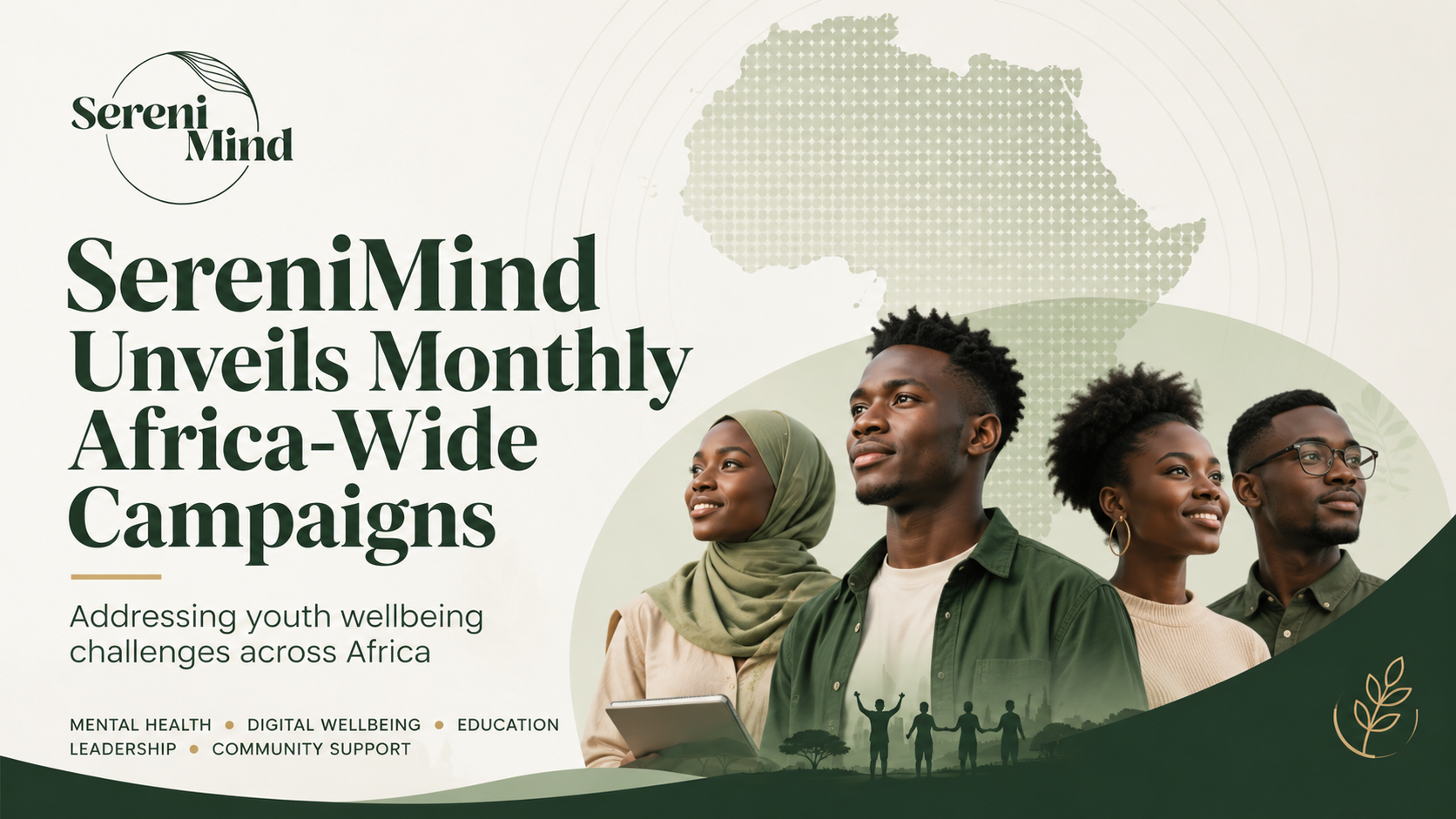
SereniMind announces monthly Africa-wide campaigns focused on youth wellbeing, mental health, child emotional wellbeing, digital wellbeing, student stress, and community support.

SereniMind, a Nigerian youth wellbeing and mental health platform, has announced plans to launch a year-round series of monthly Africa-wide campaigns aimed at addressing some of the most pressing wellbeing challenges affecting young people across the continent.
The initiative is designed to move youth mental health advocacy beyond one-off awareness posts and occasional conversations into a structured continental campaign model that addresses a different issue every month, including child emotional wellbeing, relationships, digital wellbeing, women and girls’ mental health, men’s mental wellbeing, student stress, suicide prevention awareness, innovation in mental health, and the state of youth wellbeing in Africa.
According to the organisation, the campaign series will serve as a long-term awareness, education, advocacy, and engagement platform for young Africans, parents, schools, communities, media organisations, civil society groups, healthcare professionals, policymakers, and development partners.
The announcement comes at a time when youth wellbeing is becoming an increasingly important development issue across Africa. The United Nations has described Africa as having the youngest population in the world, with about 70 percent of sub-Saharan Africa under the age of 30, making youth empowerment central to the continent’s future.
Health experts have also continued to raise concerns about mental health among children, adolescents, and young people. The World Health Organisation and UNICEF estimate that one in seven children and adolescents aged 10 to 19 is affected by mental health conditions, while early action remains important because many mental health conditions begin before adulthood.
In Africa, the mental health gap remains significant. The WHO Regional Office for Africa reported in 2025 that mental health conditions affect about 150 million people across the continent, amid insufficient access to care services.
SereniMind says its monthly campaign model is intended to respond to this reality by creating continuous, targeted conversations around the different social, emotional, digital, academic, and economic pressures shaping the lives of young Africans.
Speaking on the initiative, Ridwan Oyenuga, Founder and CEO of SereniMind, said youth wellbeing must be treated as a development priority, not only as a health concern.
“Africa’s future is often discussed in terms of infrastructure, technology, entrepreneurship, education, and economic growth. These are important, but the young people expected to drive that future must also be supported emotionally, mentally, and socially. If we ignore youth wellbeing, we weaken the very foundation of Africa’s development,” Oyenuga said.
He added that SereniMind’s goal is to build a consistent continental movement that brings attention to issues many young people experience but rarely discuss openly.
“Every month, we want to focus attention on a specific wellbeing issue affecting young people across Africa. We are not just creating campaigns for visibility. We are creating conversations that can educate families, support schools, guide communities, engage policymakers, and encourage young people to seek help, speak up, and feel seen,” he said.
The new campaign structure builds on SereniMind’s growing work through the Africa Wellness Voices Initiative, a continental awareness project that the organisation says reached more than 100 million people across over 25 African countries through media visibility, digital storytelling, advocacy, and partnerships.
Through that initiative, SereniMind amplified conversations around youth wellbeing, emotional health, stigma reduction, community support, and the need for Africa to place mental wellbeing at the centre of development planning.
The organisation says the new monthly campaign calendar will expand that work into a more consistent year-round movement.
The campaign themes will cover a wide range of youth wellbeing issues. These include emotional connection and healthy relationships, women and girls’ wellbeing, digital wellbeing in the age of artificial intelligence and social media, Africa Mental Health Awareness Month, men’s mental wellbeing, child emotional health, youth leadership and wellbeing, back-to-school stress, suicide prevention awareness, mental health innovation, and the annual State of Youth Wellbeing in Africa conversation.
One of the major campaign areas will focus on child emotional wellbeing, under the theme “The Child Behind the Smile: Every Behaviour Has a Story.” The campaign will encourage parents, teachers, caregivers, and communities to pay closer attention to children’s emotional needs, behavioural changes, silent struggles, and the importance of raising children who feel seen, heard, and safe.
SereniMind says this campaign is especially important because many conversations around children focus heavily on academic success, discipline, and physical health, while emotional wellbeing is often overlooked.
The organisation believes that child mental health and emotional development must become a stronger part of Africa’s education, parenting, public health, and community development conversations.
Another key area will be Digital Wellbeing Africa, which will explore the impact of technology, artificial intelligence, social media, online safety, cyberbullying, digital pressure, and screen culture on young people’s mental wellbeing.
As African countries continue to invest in digital transformation, SereniMind says the continent must also pay attention to the psychological effects of the digital environment on young people.
The organisation noted that technology can be both a challenge and a solution. While social media and digital platforms can create pressure, comparison, misinformation, and online harm, they can also improve access to mental health education, peer support, telehealth, digital counselling, and AI-powered wellbeing tools.
SereniMind also plans to dedicate specific campaigns to women, girls, and leadership wellbeing, especially around International Women’s Day. This campaign will highlight the emotional and mental health challenges faced by young African women and girls, including social expectations, leadership barriers, gender-based pressures, academic stress, workplace demands, and access to support systems.
For June, the campaign will focus on Men and Mental Wellbeing Africa, addressing emotional silence, help-seeking behaviour, masculinity, stigma, and the need to create safer spaces for boys and men to discuss their struggles without shame.
The organisation says this is important because many boys and men are raised in environments where vulnerability is discouraged, making it harder for them to seek support early.
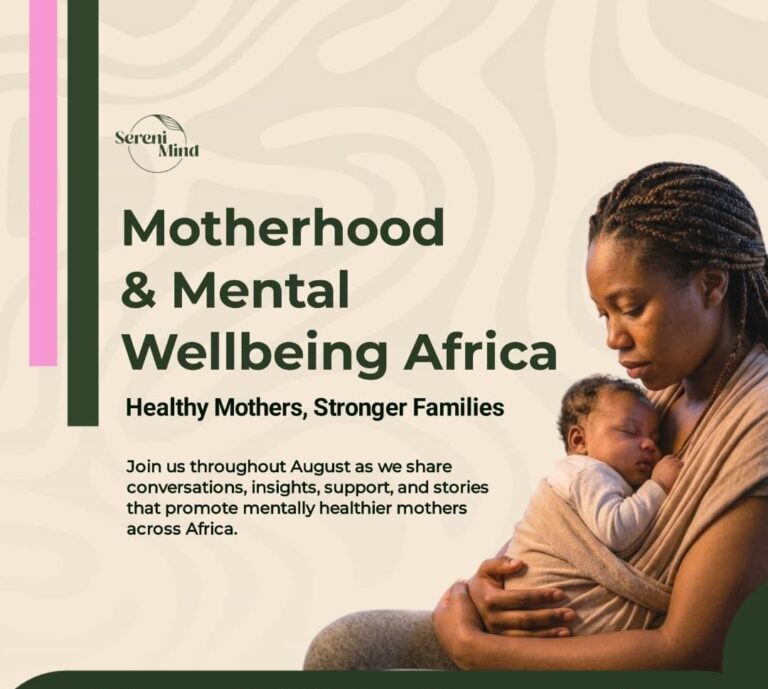
In August, SereniMind plans to run a Motherhood, Recovery and Mental Wellbeing in Africa Campaign, focusing on maternal mental health during pregnancy and the postpartum period, physical and emotional recovery after childbirth, breastfeeding support, mother-child bonding, the demands of motherhood, and the importance of supporting mothers as they raise emotionally healthy children.
September will focus on Suicide Prevention Awareness, with emphasis on prevention education, early support, community awareness, safe conversations, and the role of families, schools, faith communities, media, and health systems in protecting young people. The campaign will avoid harmful language and instead focus on hope, support, prevention, and community responsibility.
October will mark Mental Health and Innovation Month, aligned with World Mental Health Day. The campaign will explore how technology, entrepreneurship, research, storytelling, data, digital platforms, and youth-led innovation can improve mental health awareness and access to support across Africa.
By November, SereniMind says it will focus on the State of Youth Wellbeing in Africa, using media features, surveys, youth reflections, expert commentary, and policy recommendations to examine the realities facing young people across the continent.
The year will end with the Africa Wellness Voices Initiative, a December flagship campaign celebrating stories, resilience, partnerships, impact, community voices, and continental progress in youth wellbeing advocacy.
According to SereniMind, the intention is to ensure that youth wellbeing is not discussed only during crisis moments or international awareness days, but consistently throughout the year.
The campaign also aligns with broader continental and global development frameworks. The African Union’s Agenda 2063 identifies wellbeing and quality of life as part of its vision for a prosperous Africa based on inclusive growth and sustainable development.
SereniMind believes this reinforces the need for governments, development organisations, educational institutions, health systems, and private sector actors to take youth wellbeing more seriously as part of Africa’s long-term development agenda.
The organisation is calling on schools, universities, youth organisations, media platforms, civil society groups, healthcare professionals, corporate institutions, development partners, faith communities, and government agencies to collaborate on the monthly campaigns.
It says partners can support through media coverage, expert contributions, school outreach, community engagement, research, digital storytelling, policy conversations, sponsorship, and awareness activities.
“This is an open call to organisations across Africa and beyond,” Oyenuga said. “Youth wellbeing is not the responsibility of one platform alone. It requires parents, teachers, journalists, policymakers, health professionals, innovators, religious leaders, community workers, and young people themselves. SereniMind is creating the platform, but the movement belongs to everyone who believes African young people deserve to thrive.”
Over the past year, SereniMind and its Africa Wellness Voices Initiative have gained visibility across multiple countries, with the organisation’s work appearing in outlets including Premium Times, The Guardian, AllAfrica, New York Parrot, and other media platforms across Africa and beyond.
The organisation says the new campaign calendar is part of its broader ambition to become one of Africa’s leading voices in youth mental health, digital wellbeing, child emotional health, student wellbeing, men’s mental health, women and girls’ wellbeing, and mental health innovation.
For SereniMind, the campaign is not only about awareness. It is about shaping the way Africa talks about human capital, productivity, education, leadership, technology, and development.
The organisation argues that a continent cannot fully benefit from its youthful population if young people are unsupported, overwhelmed, disconnected, or unable to access the help they need.
As Africa’s youth population continues to grow, development experts have increasingly emphasised the importance of investing in young people as drivers of innovation, productivity, and sustainable growth. UN Africa Renewal reported that Africa’s youth population is projected to double to more than 830 million by 2050, further strengthening the case for youth-centred development planning.
SereniMind says its campaign series is one contribution to that larger continental conversation.
The organisation hopes that by addressing a different youth wellbeing issue every month, it can help normalise mental health discussions, reduce stigma, support early awareness, promote emotional intelligence, encourage help-seeking, strengthen families and schools, and position wellbeing as a central pillar of Africa’s future.
The first phase of the campaign series is expected to begin with The Child Behind the Smile, a child emotional wellbeing campaign focused on helping parents, caregivers, teachers, and communities understand that every child’s behaviour has a story and every child deserves to feel safe, heard, and supported.
For SereniMind, this is the beginning of a wider movement.
A movement to make youth wellbeing visible.
A movement to ensure African children and young people are not only educated, connected, and ambitious, but also emotionally supported.
A movement to place mental health, wellbeing, and human dignity at the centre of Africa’s development future.
As the organisation prepares to roll out the campaign series across digital platforms, media partnerships, schools, communities, and youth networks, its message is clear:
Africa’s future will not be built by technology, infrastructure, and policy alone.
It will be built by young people who are healthy enough, supported enough, and empowered enough to lead.
About The Author